Audiologists can use natural phenomenon to determine the nature of an individual’s hearing loss and ascertain valuable diagnostic information.
Meet Our New AI-Powered Notes Assistant. Learn more
Learn more about the features that will empower your clinics and elevate hearing care
We partner with hearing care providers, helping every team and leader deliver consistent, data-driven, high-quality care.
Our connected audiological solutions integrate effortlessly to support your entire hearing care workflow.
Expert insights, guides, and learning resources designed to help you provide best care experiences.
We are dedicated to provide up-to-date, comprehensive insights in hearing care to ensure you can deliver best care experiences to your patients.
Audiologists can use natural phenomenon to determine the nature of an individual’s hearing loss and ascertain valuable diagnostic information.
Our sleek and stackable audiometer and fitting unit seamlessly integrates into any clinic decor, optimizing space while maintaining a modern aesthetic. With advanced features like portability and precise diagnostic capabilities, our audiometer revolutionizes testing and increases efficiency and accuracy.
In order to complete a bone conduction test during pure tone audiometry, clinicians use many of the same tools needed for air conduction testing: a soundproof booth and a reliable and accurate audiometer. They will also need a bone oscillator to transmit bone conducting stimuli to the patient.
Step 1
The bone oscillator is placed on the mastoid process of the ear the clinician would like to test and pure tones are presented. It should be placed as close to the ear as possible while not touching the ear itself.
Step 2
Similar to air conduction testing, the patient’s responses to those tones will be recorded. The patient will be asked to respond when a stimuli is detected. These responses will then be recorded on the audiogram. While pure tone audiometry via air conduction is tested from 250 – 8000 Hz, bone conduction testing is performed at 250 – 4000 Hz due to the limits of the bone oscillator.
Step 3
When performing bone conduction testing, although the oscillator is placed on the mastoid process of the intended ear, the entire skull will vibrate, and thus the better cochlea will always be the one responding. Masking is the process of introducing noise, often narrowband noise, into the non-test ear. This ensures that the intended ear is the only one being stimulated.
Experience the perfect synergy of cutting-edge hardware and software solutions. Elevate patient care, streamline workflows, and achieve outstanding results. Discover how our innovative solutions can revolutionize your audiology practice and generate leads for your business. Take the first step towards unlocking your practice's full potential by contacting us now.
Streamline your Bone Conduction Audiometry tests and elevate patient care with our intuitive and configurable software. Designed for efficiency and flexibility, our platform fits any clinic's needs and budget.
Simply put, bone conduction is the conduction of sound directly to the inner ear through the bones of the skull, thus bypassing the outer and middle ear.
Sound waves are vibrations that travel through the air and are picked up by the ear. When we hear via air conduction, sound travels through the air and into the outer ear, through the outer ear and into the middle ear, through the middle ear, and into the inner ear, which then transfers sound to the brain.
In contrast, bone conduction bypasses the outer and middle ear and sends sound straight to the inner ear, or cochlea. It does so through vibrations as well, but in this case, vibrations of the skull. By vibrating the skull, sound reaches the bony inner ear directly.
There is a myriad of factors that affect bone conduction and how sound reaches the inner ear during this phenomenon. Bone thickness at different points on the skull, the fact that the skull is comprised of different sections fused together, placement of the bone oscillator, as well as the depth of the compressed tissue underneath all affect sound transmission. It has been found that the closer the transducer is to the cochlear, the better the sound will be transmitted.
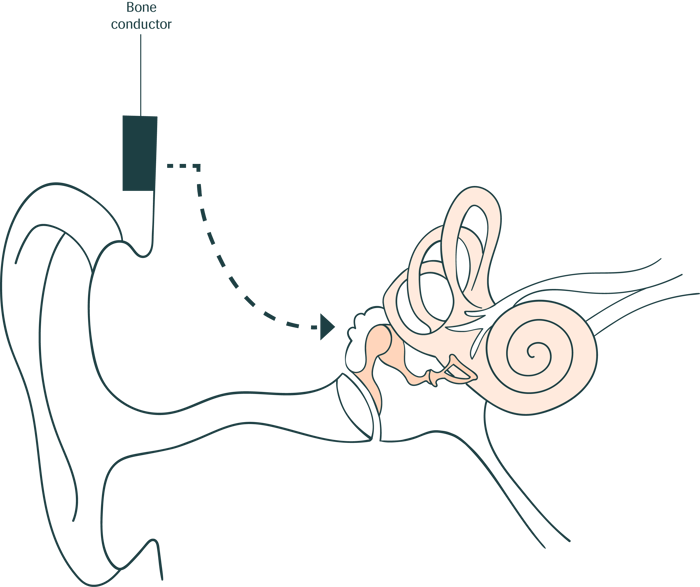
Bone conduction testing is invaluable when determining differential diagnosis. It can be performed during pure tone audiometry to determine the severity of loss in the inner ear, and thus, the nature of the hearing loss, whether it is conductive, sensorineural, or mixed. If an individual has a middle ear problem, sound will be diminished when travelling through that area of the ear and thus by attenuated by the time it reaches the healthy inner ear. Where bone conduction and air conduction thresholds match, the indication is that the hearing issue is in the inner ear. Where there is a discrepancy, and the thresholds have been verified with masking, the indication is that the hearing problem lies within the outer or middle ear. Having this differential diagnosis is important for the treatment and management of hearing loss. Issues with the middle ear will be treated very differently than those of the inner ear.
Bone conduction testing can also be performed during auditory brainstem response (ABR) testing. A bone oscillator, like what is used during pure tone audiometry, is used to transmit stimuli. ABR responses are then recorded. Audiologists can then determine hearing acuity in the inner ear alone.
Vibrations can also be transmitted using tuning forks. Tuning forks are metal implements that when struck, vibrate at a specific pitch. They can then be placed on the skull to transmit that pitch to the inner ear or cochlear. Tuning fork tests are a quick way for providers to get preliminary data on an individual’s hearing loss. These tests can also be used to support audiometric results.
Measure E-learning
We are delighted to present this comprehensive e-learning course aimed at providing an in-depth understanding of Pure Tone Audiometry and its functionalities within Measure software covering Air Conduction vs Bone Conduction test. Whether you're a seasoned audiologist looking to refresh your knowledge or a beginner eager to grasp the essentials, this course has something valuable for you.
Experience the perfect synergy of cutting-edge hardware and software solutions. Elevate patient care, streamline workflows, and achieve outstanding results. Discover how our innovative solutions can revolutionize your audiology practice and generate leads for your business. Take the first step towards unlocking your practice's full potential by contacting us now.