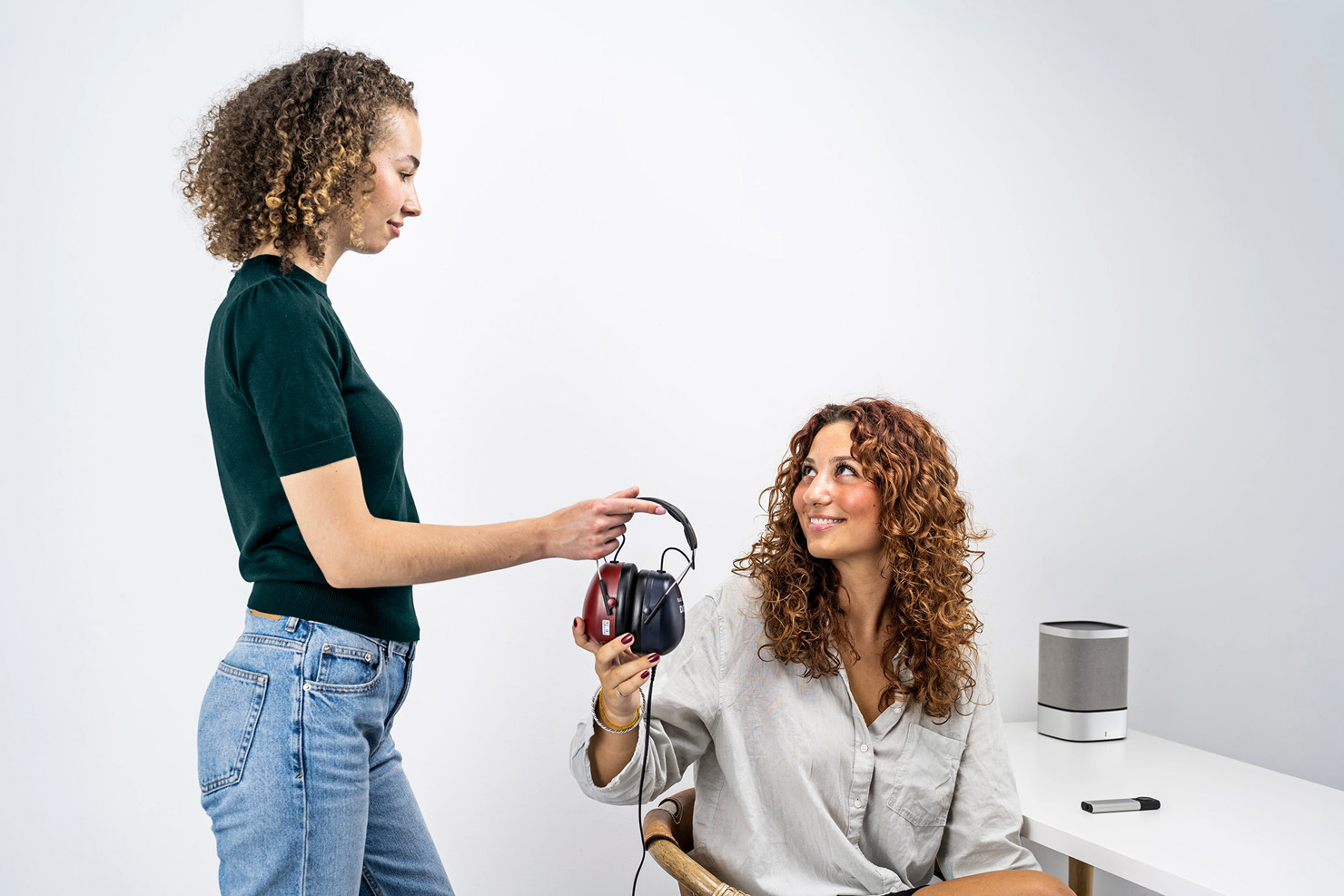
Pure-Tone Audiometry
Pure-tone testing is the most common type of hearing test and measures the hearing threshold of each ear separately using an audiometer, a calibrated instrument used to measure hearing. Pure-tone audiometry is sometimes also called air conduction testing since the sounds go through the outer and middle ear.
The testing process generally looks something like this:
- The patient is seated in a quiet space and fitted with earphones or insert phones.
- The audiologist plays a series of sounds or tones over the earphones.
- Every time a sound is heard, the patient indicates it by pressing a button, raising a hand, or pointing to the ear where the sound is heard.
- The audiologist records the results in an audiogram.
Bone Conduction Audiometry

A bone conduction audiometry test helps an audiologist to determine if there is a problem in the outer or middle ear, generally known as conductive hearing loss. Bone conduction testing can also identify inner ear problems that may indicate sensorineural hearing loss. The testing process usually proceeds along these lines:
- The audiologist places a small device behind the patient’s ear or on the forehead.
- The audiologist sends a series of sounds through the device that cause the skull to vibrate gently.
- These vibrations allow the sound waves to bypass the outer and middle ear, going instead directly to the inner ear, or cochlear.
Audiometric Masking
A narrow band noise is played through either supra-aural or insert headphones. The level of noise presented through the headset is calculated by the audiology clinician according to BS EN ISO 389-4 or by using Masking Noise (M) + 10. M is calculated as being the lowest level of masking that the client can detect and is measured in dB.
Auto - Hughson Westlake
Hughson Westlake protocol is an ascending technique of Audiometry which is done using 5-dB steps. It is based on the thought that short tone bursts are better heard against a background of silence rather than a continuous tone separated by a short interval when the level is being changed. Developed in 1944 it was adapted in the 1960’s to be automated.
Speech Audiometry
A speech audiometry test is used to assess a client’s ability to recognize speech in a variety of situations. People who have hearing loss often say that hearing speech is the one area where they have the most trouble, especially when they are trying to understand speech in a noisy setting.
While there are a variety of speech tests used in the audiometry practice, most clinics start with 3 basic forms of testing:
- Speech detection threshold test (SDT) gauges a patient’s hearing ability based on the presence or absence of stimuli. A series of words is played at steadily decreasing volumes, and the SDT measures the lowest level at which the presence of a speech signal can be heard 50% of the time, whether or not the patient can interpret specific words.
- Speech recognition threshold test (SRT) is similar to the SDT, but focused instead on recognition and identification of words. SRT measures the lowest hearing level at which the patient can correctly perceive and repeat 50% of the speech stimuli. The speech material used may be words spoken by the operator or pre-recorded and played through headphones. (Recorded presentations are recommended because recorded materials standardize the test procedure.)
- Supra-threshold recognition testing (STR), also known as word-recognition or speech discrimination testing, measures the client ability to understand speech at a comfortable listening level. Patients are played a series of words and the audiologist assesses how well they interpret different kinds of words. If the speech discrimination is poor, speech may sound garbled. Word recognition scores can be helpful in predicting the usefulness of a hearing aid.
Speech-in-noise (SIN)
More advanced speech testing takes into account how speech is understood in the presence of noise. A series of words are played, accompanied by various noise types such as white noise, speech noise, babble noise, or running speech. The accuracy with which the patient interprets words backed by different noise sources provides useful information about the signal-to-noise ratio (SNR) at which the patient can understand speech.
Quick Speech In Noise (Quick-SIN)
The QuickSIN is a speech-in-noise test that quickly and easily measures the ability to hear in noise. Speech understanding in noise cannot be reliably predicted from the pure tone audiogram or other standard audiometric tests. The QuickSIN test should be used on all adult patients as part of the audiometric test battery.
Weber
This type of hearing test uses Tuning forks to establish whether a hearing loss is present at the frequency of the tuning fork which is being used. It is not a substitute for performing additional Audiological assessments.

Threshold Equalizing Noise (TEN)
Pure tone signals can be heard in adjoining hair cells if the signal is loud enough; as a result, it is not possible to use pure tone audiometry to identify dead regions in the cochlea. Identifying dead regions in the cochlea is important for clients who have a severe to profound hearing loss, those with a steeply sloping hearing loss and those with extremely poor speech discrimination.

SISI - Short Increment Sensitivity Index
SISI is a test of the ability of an individual to recognise 1dB increases in intensity during a series of pure tone bursts. This was designed to assist in the determination of where the hearing impairment arose from. In management of hearing impairments, it is important to understand where the issue arises from, whether it is Cochlear or Retrocochlear. In a Cochlear disorder the patient will be able to differentiate the 1dB steps where an individual who has a retrocochlear disorder will not.
Free Field
Free Field Audiometry provides the clinic an option for assessing individuals who are unable to wear headphones of any description. Instead of headphones, the sounds are presented via a speaker placed in front of the patient.
Tympanometry - Test of the Middle Ear
Tympanometry, also known as a test of the middle ear, is designed to determine how well the eardrum is functioning. A healthy eardrum will allow sound to pass through it unimpeded. A tympanometry test detects problems such as fluid behind the eardrum, perforated eardrum and abnormal movement of the eardrum.
Tympanometry involves plugging the ear and slowly increasing the air pressure in the ear canal in order to measure the response of the eardrum. Acoustics Reflex - Presenting a loud sound to the patient through an ear canal probe provides a protective reflex of the Stapedius muscle; this contraction results in an increased impedance which the probe records as decreased compliance. This test can be used to confirm the results of a full battery of hearing assessments, (for example, eustachian tube function).
Otoacoustic Emissions (OAE)
An otoacoustic emissions (OAE) test is used to find out how well the inner ear, or cochlea, works. Otoacoustic emissions are low intensity sounds originating from the outer hair cells of the healthy cochlea and can be measured in the outer or middle ear.
If the ear is functioning normally, it will produce OAEs. If there is a hearing loss greater than 25-30 decibels (dB) the test will fail due to no OAEs. This test can also show if there is a blockage in the patient’s outer or middle ear. If there is a blockage, no sounds will be able to get through to the inner ear. This means that no vibrations or sounds that come back.
FAQ
-
A general hearing test is often called a hearing exam, hearing assessment, or audiometry test. The results are usually shown on an audiogram, which is the chart that displays how well each ear hears different pitches and volumes.
-
Hearing is measured with an audiometer, a specialized instrument that plays calibrated tones through headphones, insert earphones, or a bone conductor. Audiometers are used for many types of hearing tests, including pure-tone audiometry, bone conduction testing, and speech audiometry.
-
The most common types of hearing tests include pure-tone audiometry, bone conduction testing, speech audiometry, tympanometry, and otoacoustic emissions (OAE) testing. Many clinics also use speech-in-noise tests to understand how well patients hear in everyday listening situation.
-
The most accurate way to assess hearing loss is a comprehensive diagnostic hearing test performed by an audiologist in a sound-treated room using calibrated equipment. This kind of evaluation typically combines pure-tone audiometry, speech audiometry, tympanometry, and sometimes additional measures like OAEs or ABR to give a full picture of the type and degree of hearing loss.
To see how accurate hearing tests are in different settings, from quick screenings to full diagnostic exams, read our guide to comprehensive hearing tests vs hearing screenings. -
Most hearing clinics store your hearing test results, audiograms, and visit notes in a secure electronic system so they can track changes over time. In larger, multi-location hearing care networks, clinics often use audiology practice management software for multi-location clinics to share your records safely between locations. That means if you book a follow-up at another branch in the same network, your audiologist can usually see your previous test results without repeating every test.
Other Blogs You Might Enjoy:

Comprehensive Hearing Test vs. Hearing Screening
Explore the role of a comprehensive hearing test as compared to a quick screening. How accurate are hearing tests, and what kind of results can we expect?

Improving Satisfaction Rates for Hearing Aid Users
Learn how to guide your customer hearing aid experience through the initial follow up period and beyond to ensure that customers remain satisfied.

4 Crucial Conversion Rates To Improve in Hearing Care
In private hearing care, there is often a discussion about how to increase conversion rates, or help rates as some prefer to call it. Many audiologists are measured on clinic performance, conversion rates, and sales, and are rewarded according to these KPIs.
Don't Miss Out On the Latest Insights On Audiology
Sign up today to receive exciting updates, tips, and the latest newsletters from Auditdata.